Zhuoqun Yuan

Jun 1, 2025

Finora

This is a dashboard design created for a SaaS company with multinational operations.

  • Industry

    FinTech

  • Responsibility

    End-to-end Designer

  • Duration

    8 Weeks

About Finora

Finora Global Solutions is a mid-sized SaaS company headquartered in London, operating across Europe, North America, and Asia.


While providing subscription-based services to its clients, Finora itself faces complex challenges managing multi-currency operations and fragmented financial data across regions.


The goal of this project is to design an internal financial dashboard that consolidates data, provides real-time insights, supports predictive forecasting, and ensures compliance through transparent audit trails — enabling finance teams to make faster, more confident, data-driven decisions.

Problems & Goal Statement

Key challenges faced by Finora’s global finance team

Fragmented Data

Different regions use separate tools and spreadsheets.

Delayed Reports

Monthly reports take 2+ weeks to compile manually.

Currency Fluctuations

Forecasts become unreliable across changing exchange rates.

Low Transparency

No unified dashboard for real-time visibility.

Design Goals for Finora’s Financial Dashboard

Centralized

Data Integration

Unify regional systems and enable real-time multi-currency overview.

Automated

Reconciliation

Reduce manual workload and errors through automation.


Predictive

Insights

Anticipate risks via data-driven forecasting.

Transparent

Compliance

Build trust through clear audit trails and access control.

Design Process

I followed a human-centered design process, moving through the five steps.

Empathize

Define

Ideate

Prototype

Test

User Persona

I conducted secondary research on enterprise SaaS dashboards and finance workflows.

and created 2 main personas by AI skills to represent Finora’s internal finance team across hierarchical roles in order to empathize and understand the Finance Team better.

Persona1 James Whitmore

Persona2 Li Na

Empathy Map

I used this empathy map to translate research findings into a clear understanding of users’ needs, motivations, and emotions.

James Whitmore

Chief Financial Officerr

Says


“We’re always late to know our real financial position.”

Thinks


A centralized dashboard would enable quicker, smarter decisions.

Does


Regularly pushes teams for faster, more accurate reports.

Feels


Pressured and anxious about delayed, unreliable data.

Li Na

Regional Finance Manager

Says


“I need to track budgets and exchange rates in real time.”

Thinks


Automated dual-currency reporting would eliminate confusion.

Does


Spends hours manually reconciling regional and HQ spreadsheets.

Feels


Frustrated by repetitive manual work yet eager for more reliable tools.

Key Insights

I distilled research findings into key insights to clearly define the core problems faced by finance teams.

1

Finance teams lack real-time data visibility across regions.

2

Reporting delays cause decision-making lags of up to two weeks.

3

Manual reconciliation increases risk of error and stress.

4

No unified KPI framework; data definitions differ between teams.

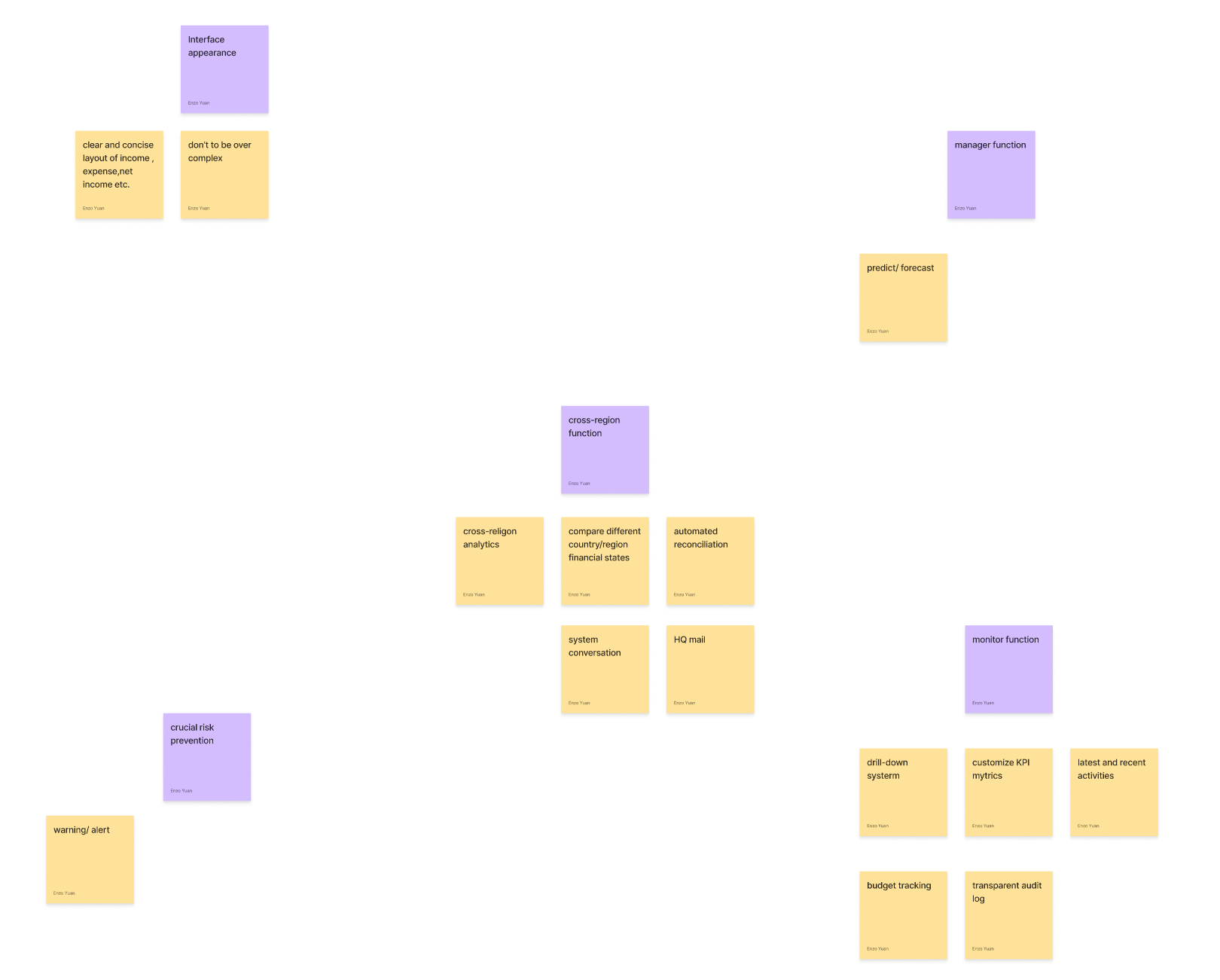
Affinity Map

I synthesized insights from user interviews and secondary research by creating an affinity map, grouping key pain points and needs into thematic clusters to reveal patterns and inform dashboard redesign priorities.

Information Architecture

I created a structured information architecture that organizes the dashboard into core sections with consistent navigation and tailored content, ensuring intuitive access to financial insights while incorporating an onboarding flow.

welcome page

Onboarding

Dashboard

Global Header

Sidebar Navigation

Right Sidebar Widgets

Financial Overall

Trend Metrics

Regional Revenue

Total Balance Trend

Income Statistics

Expenditure Categorie

Exchange Rates

Prediction

Global Header

Sidebar Navigation

Right Sidebar Widgets

Risk Alert

Predict Model

Predict Graph

Scenario Analysis

Scenario Select

KPI

Global Header

Sidebar Navigation

Right Sidebar Widgets

KPI Summary Cards

KPI Trend Chart

Analysis Breakdown

Detailed Risk Breakdown

Contact Responsible Manager

Budget

Global Header

Sidebar Navigation

Right Sidebar Widgets

AI Score

Ai Suggestion

Budget Related Graph

Budget reallocation

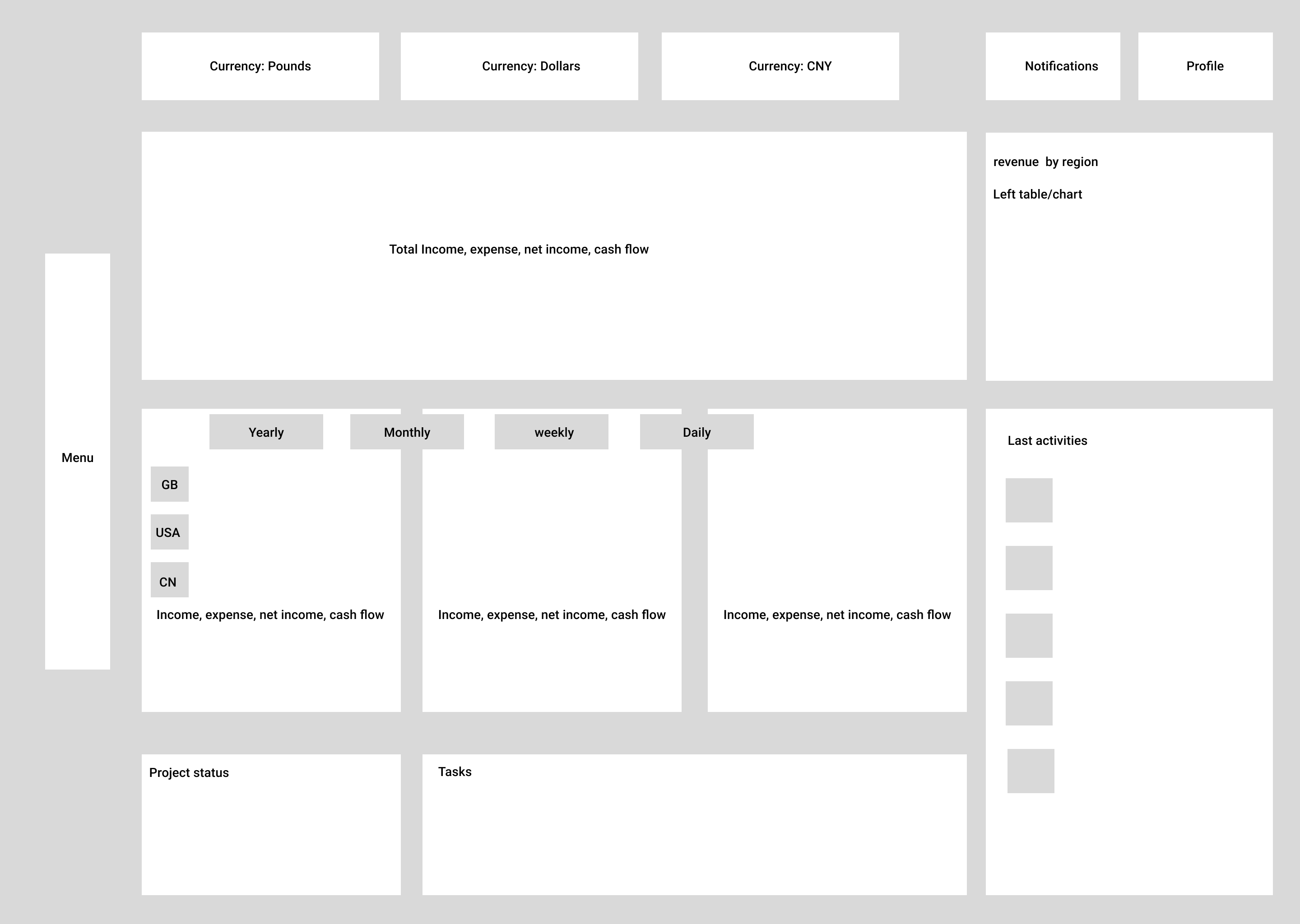
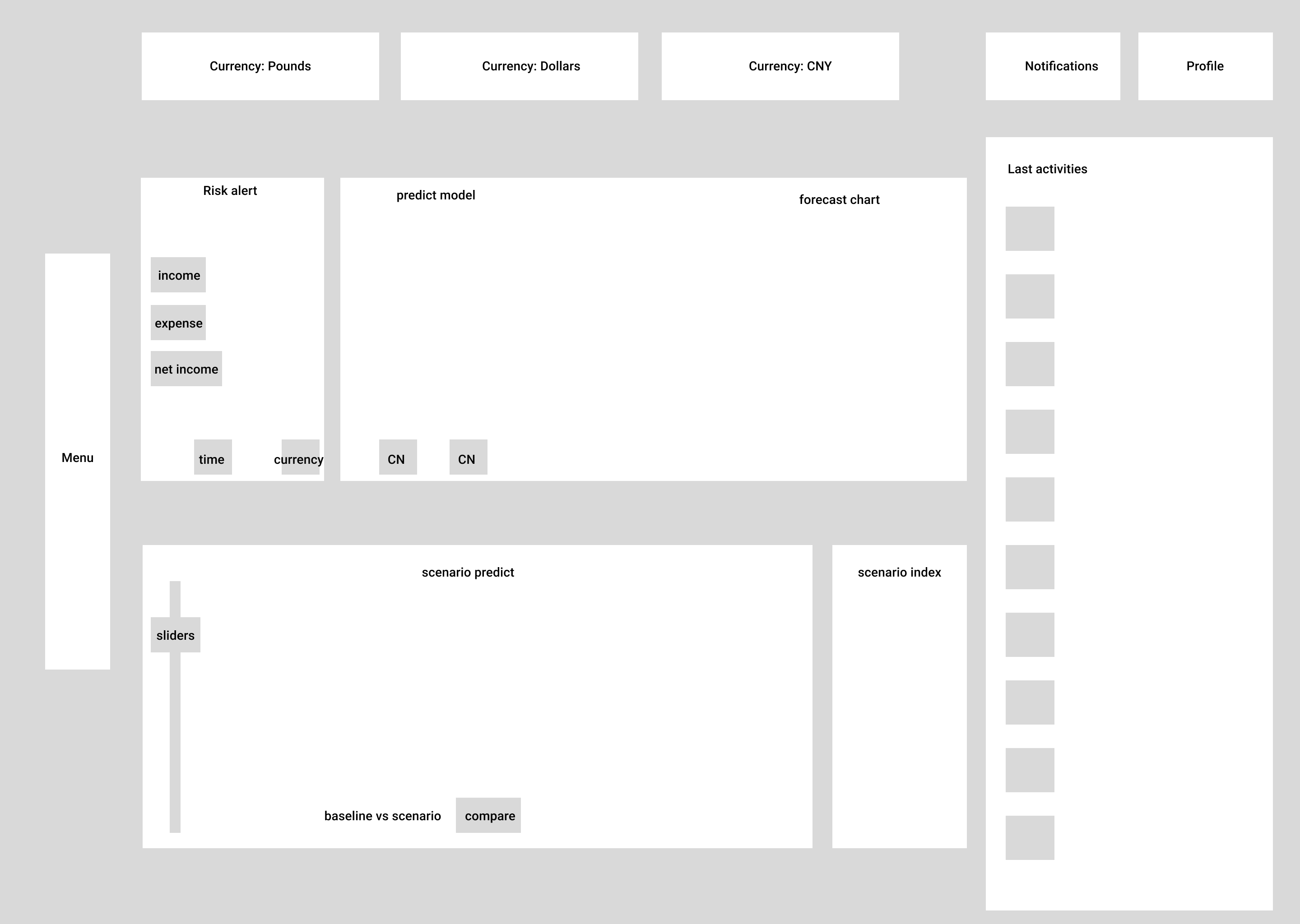
Low-fi Prototype

I created low-fidelity wireframes to explore layouts and user flows, validating the structure and feature priorities before advancing to high-fidelity designs.

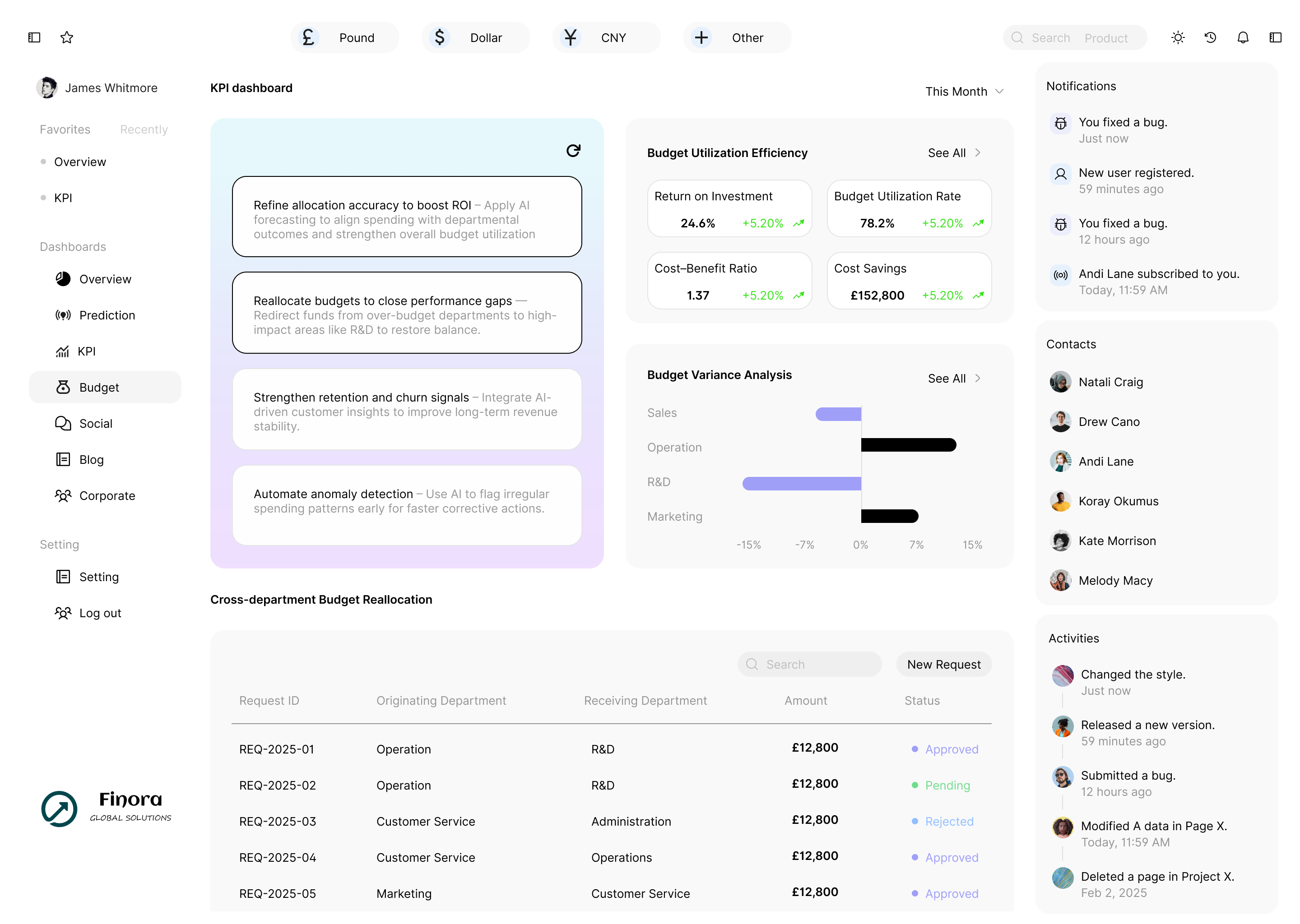
Dashboard low-fi prototype

Prediction low-fi prototype

KPI low-fi prototype

Budget low-fi prototype

Iteration

I conducted iterative refinements on key screens through multiple rounds of feedback, progressively enhancing visual hierarchy, optimizing layouts for readability, and adding contextual elements to improve usability and alignment with user needs.

Added residual background elements from the previous step, enhanced the avatar, and optimized the padding.. Optimized the ‘frame-in-frame’ structure, added local headings to improve recognizability, and further refined the padding

KPI prototype

Merged the cards, structured the content using a top-down (general-to-specific) approach, and arranged the corresponding functionalities.”Reworked the card format to create a more cohesive overall look and a smoother structural flow.

Budget prototype

Design System

I created a design system to ensure visual consistency, efficiency, and scalability across all interfaces.

Color Palette

Card Backgrounds

income

#e6f8fc

outcome

#e6f1fd

netIncome

#e6eafc

cashFlow

#e6fcfa

Chart Colors

purple

#9f9ff8

teal

#96e2d6

blue

#92bfff

green

#94e9b8

Typography

Font Sizes

xs (8px)

Sample text

sm (13px)

Sample text

md (18px)

Sample text

Headings

Heading 1

28px / bold

Heading 2

20px / bold

Heading 3

16px / bold

Data Visualization

Income 40%

Expenses 30%

Savings 30%

Text Colors

Primary

#000000

Sample

Secondary

rgba(0,0,0,0.4)

Sample

Components

Stat Cards

Income

£76,700

+11.01%

Outcome

£50,200

-0.03%

Net Income

£23,500

+11.01%

Cash Flow

£10,600

-0.03%

Buttons

Primary

Secondary

Hover

Disabled

Border Radius

8px

10px

12px

16px

Spacing, Shadows & Icons

Shadow Levels

Small

sm

Med

md

Large

lg

Icon System

up

down

chart

filter

Spacing Scale

4px

8px

12px

16px

24px

32px

I designed four core interaction flows—Central Dashboard, Predictive Insights, KPI Tracking, and AI-based Score to meet different roles need.

Interaction Flow

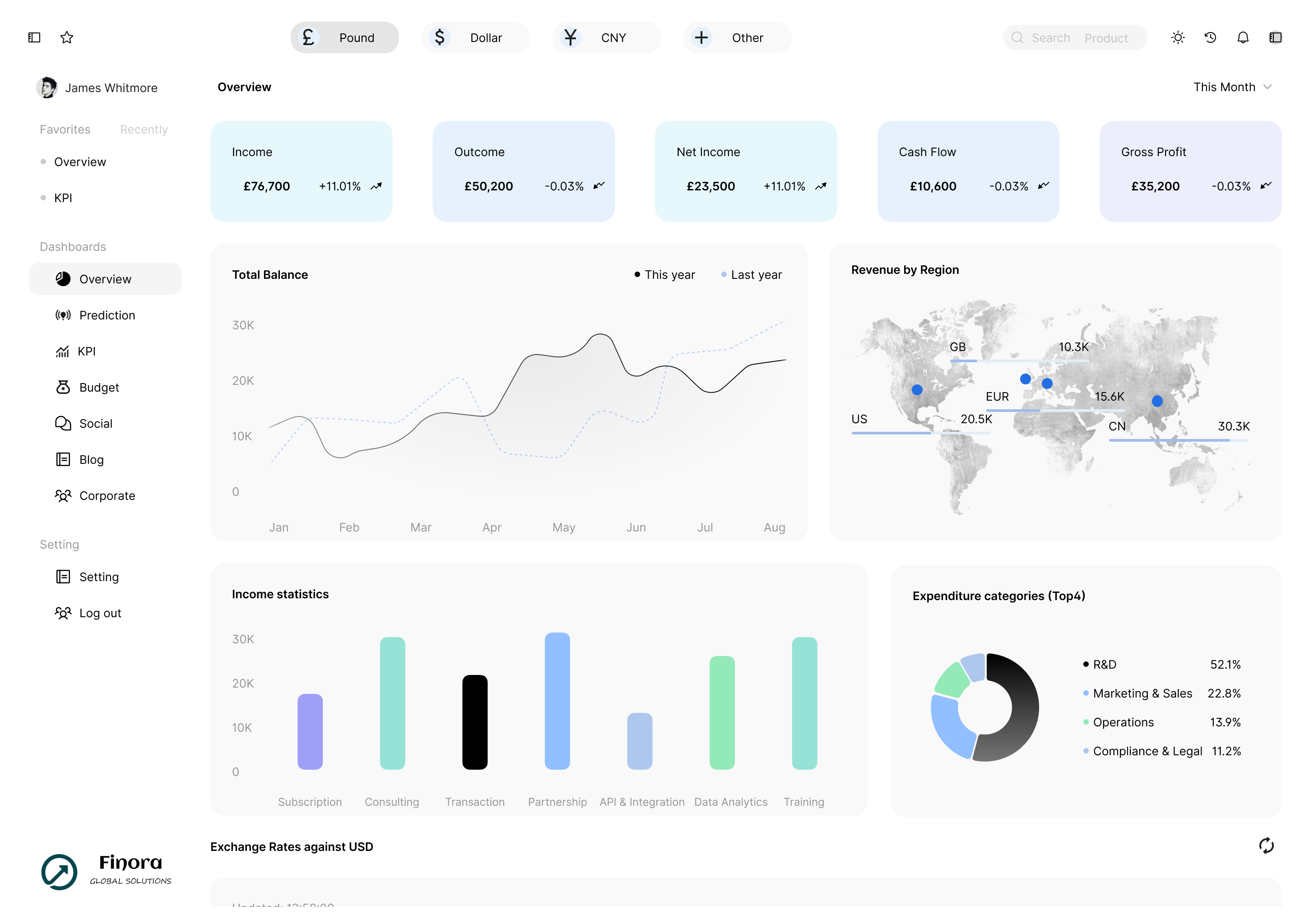
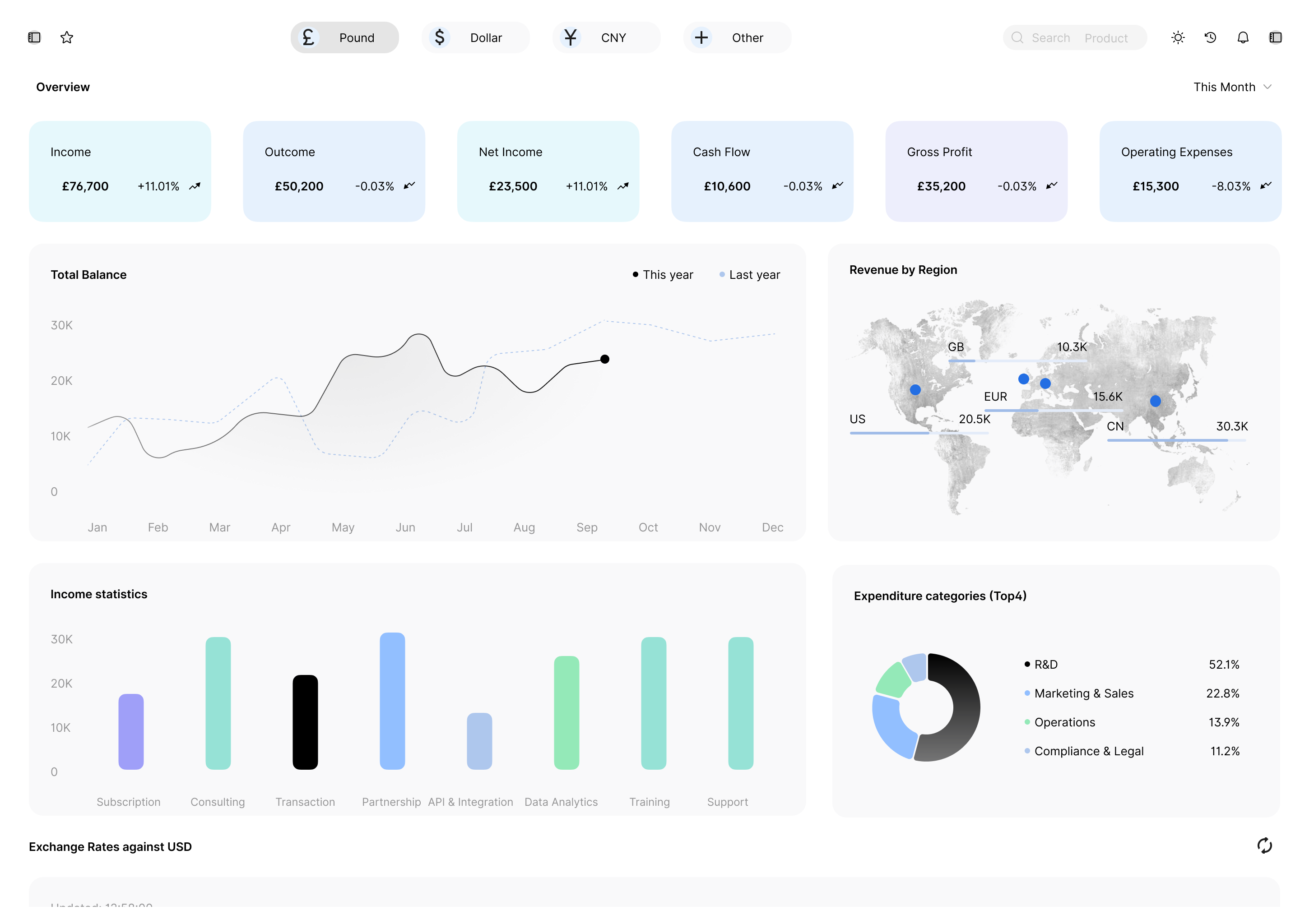
Central Dashboard

Provides a real-time overview of key financial metrics in one centralized view.

Predictive Insights

Uses historical data to forecast trends and highlight potential financial risks.

KPI Tracking

Consolidates core KPIs to support faster, data-driven decision-making.

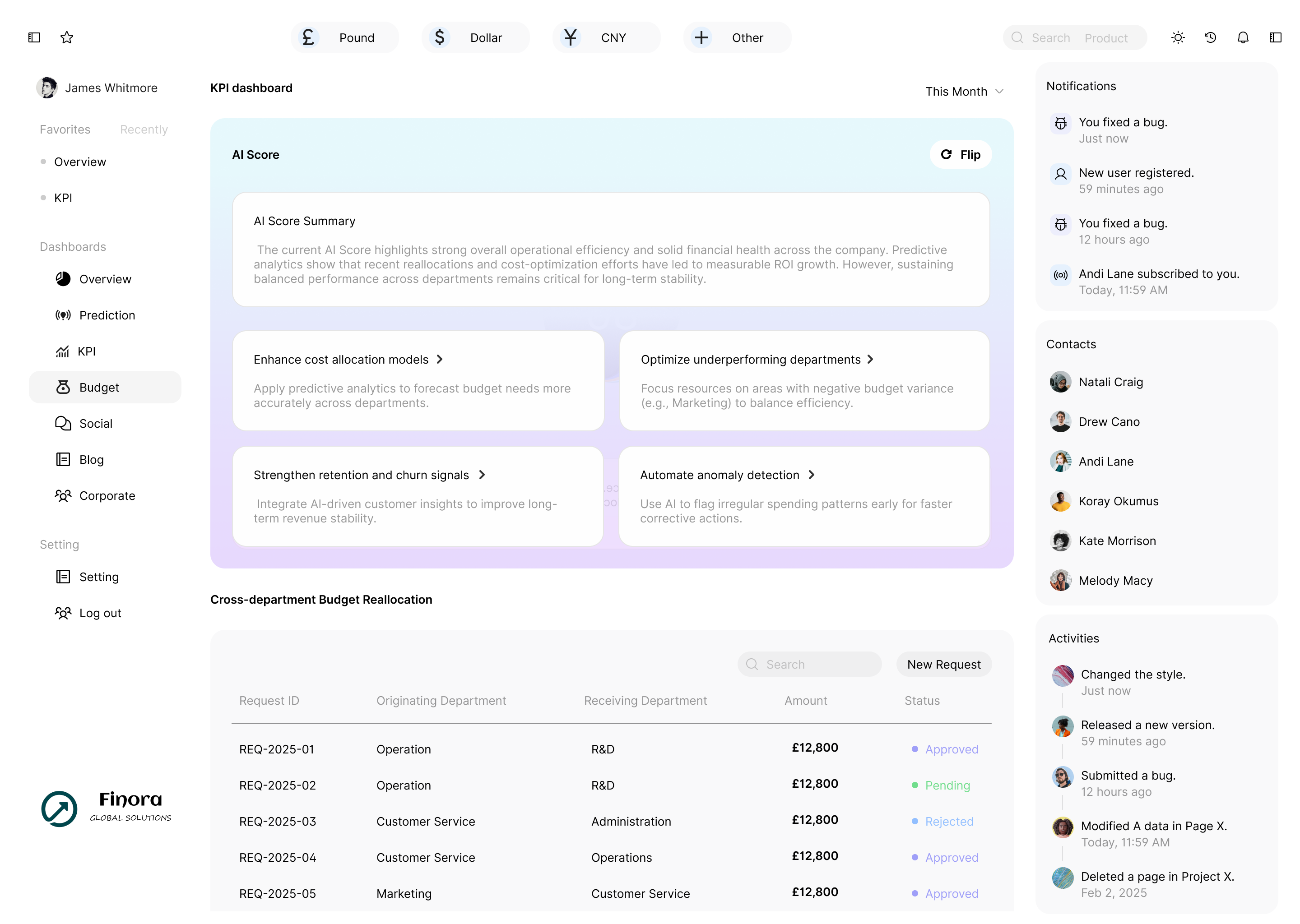
AI-driven Score

Summarizes financial performance into a single, easy-to-understand intelligence score.

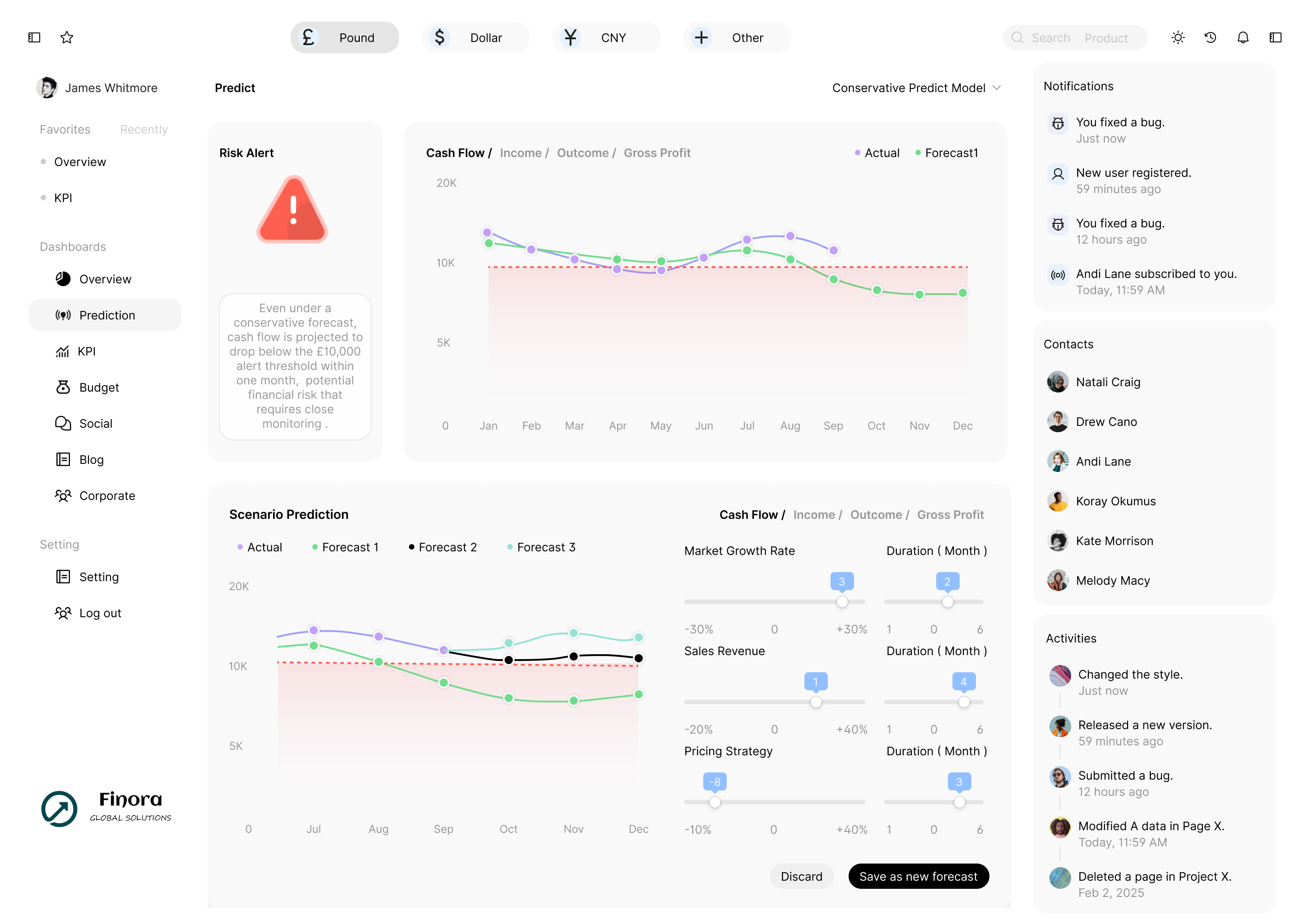
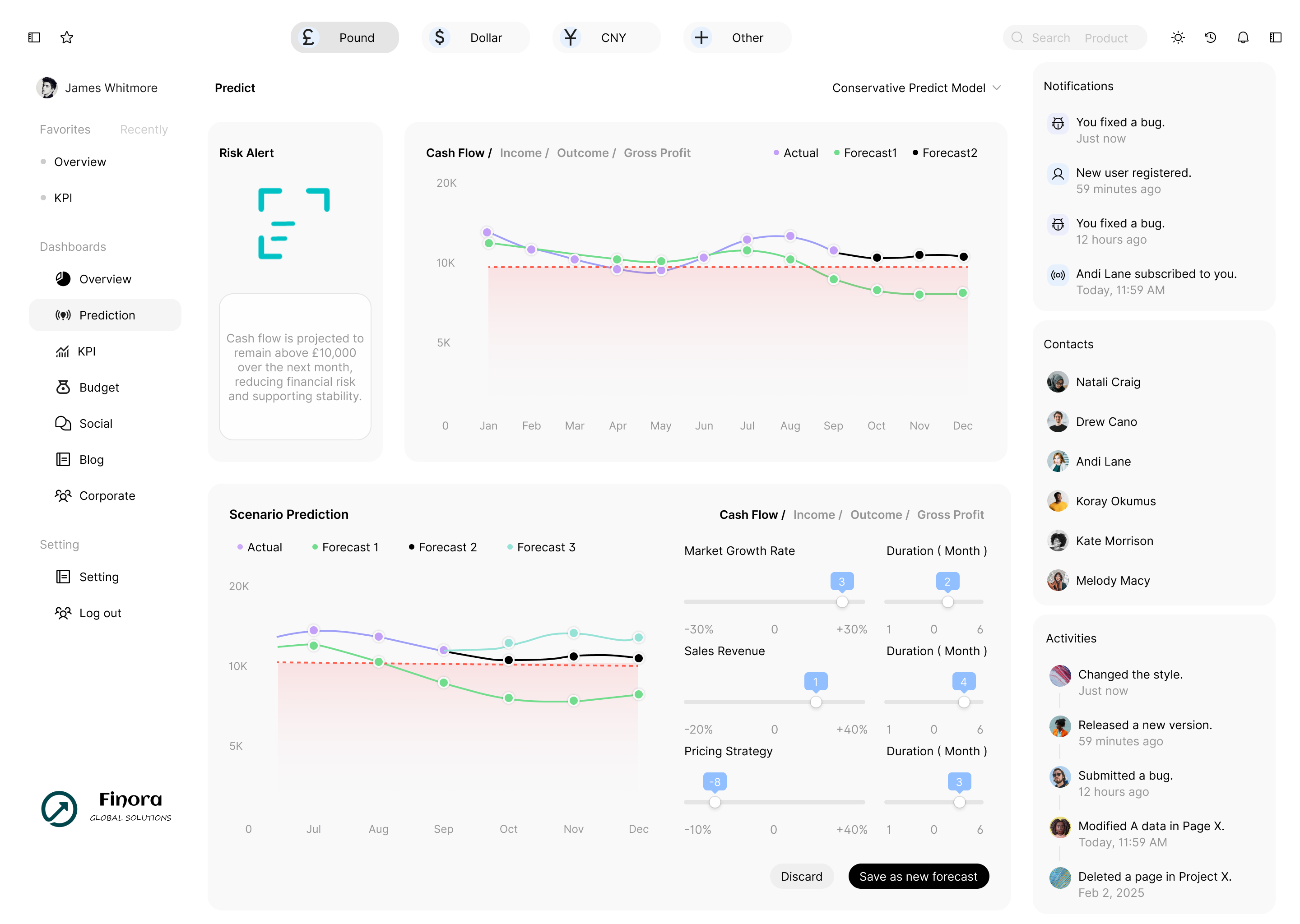
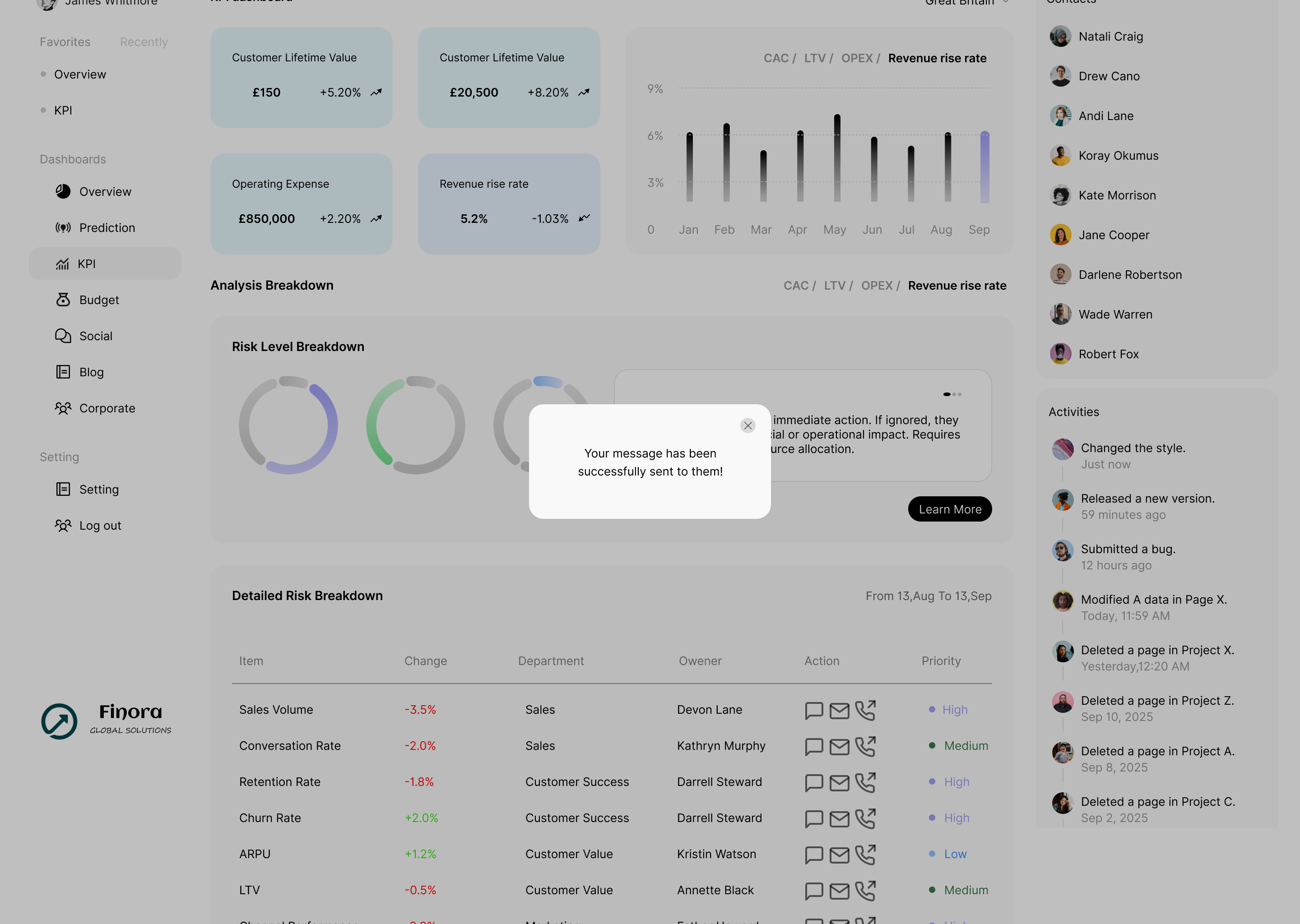
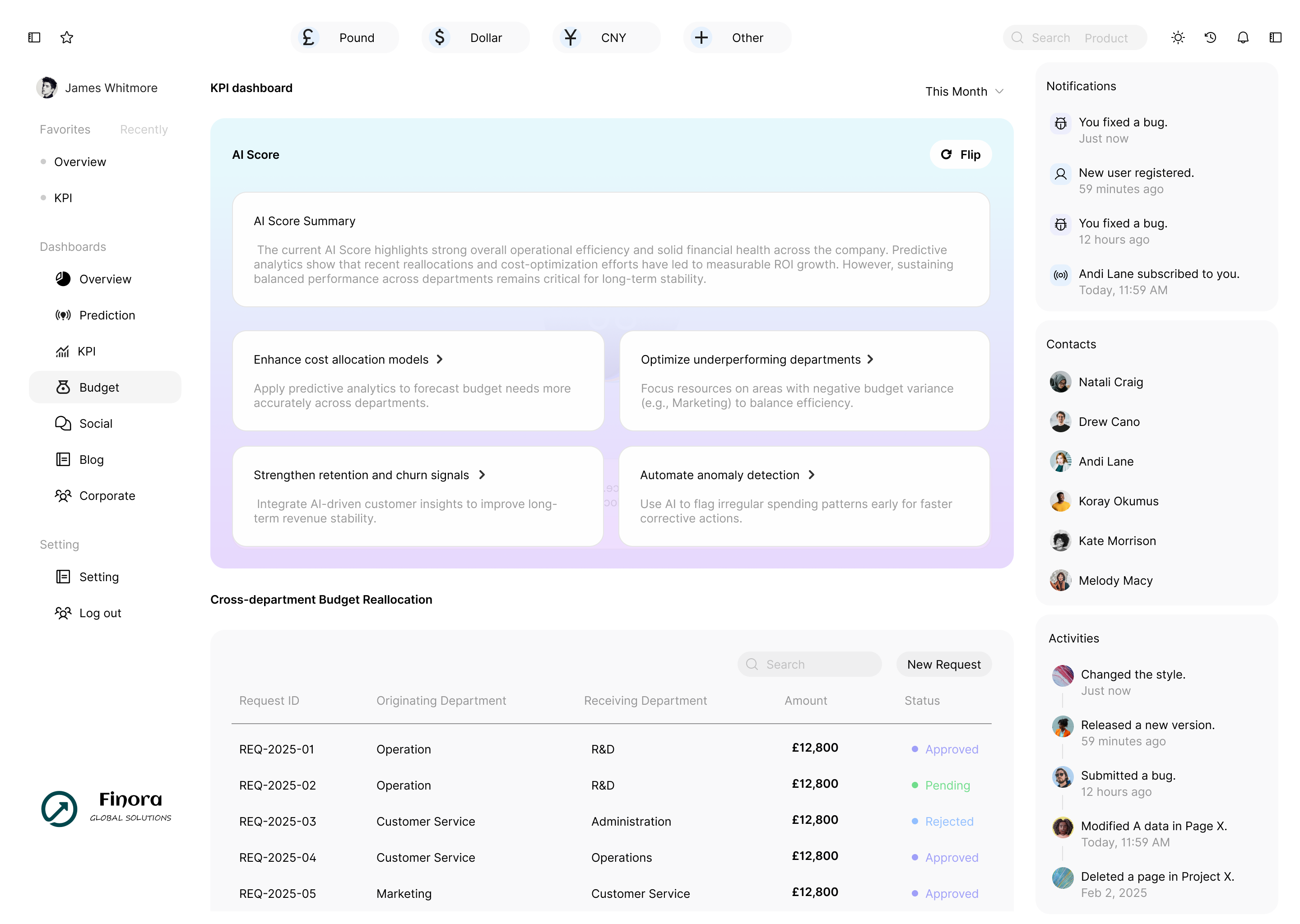
Hi-fi Prototype

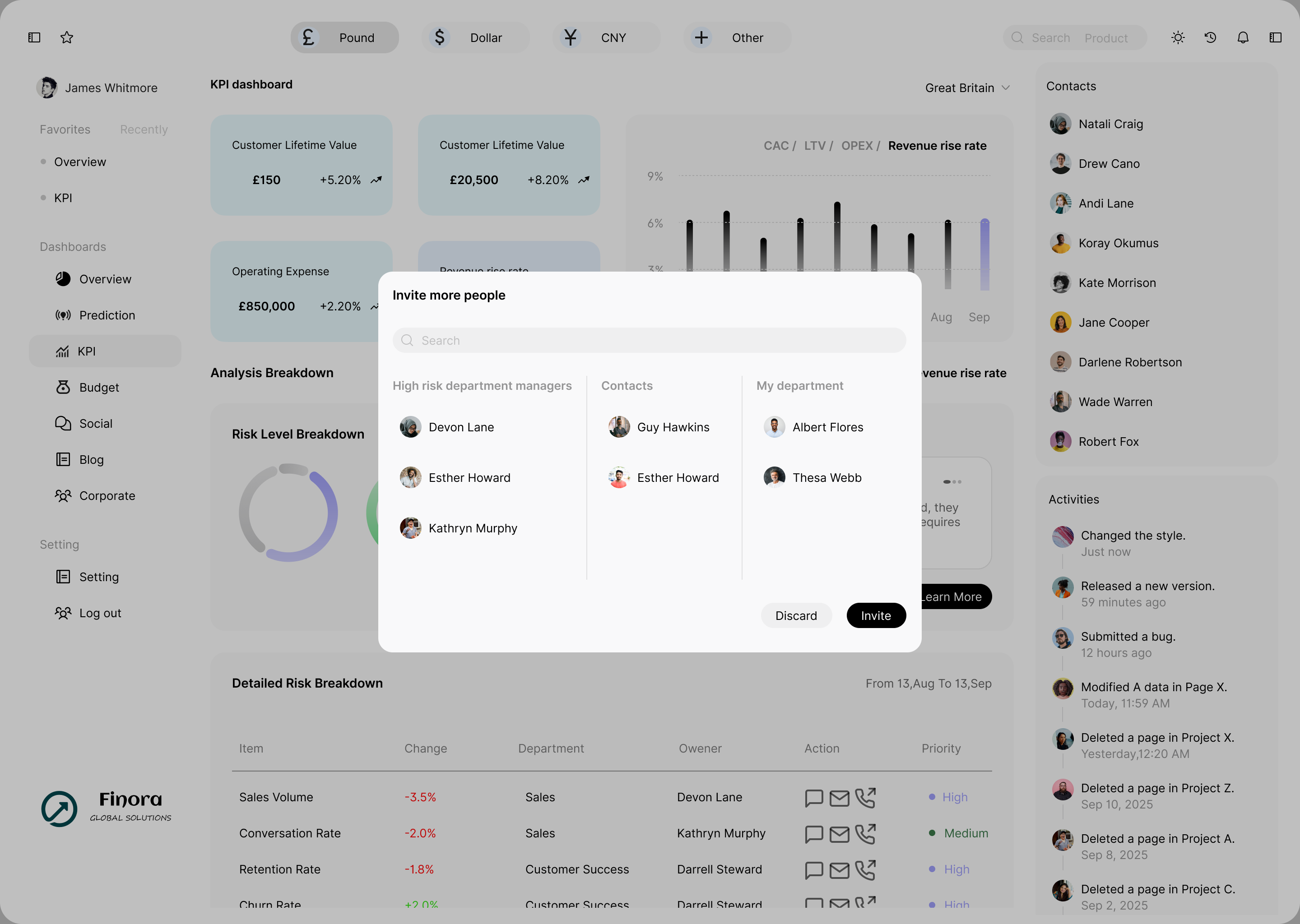
Dashboard hi-fi prototype

Prediction hi-fi prototype

KPI hi-fi prototype

Budget hi-fi prototype

Self-reflection

Through user research and persona analysis, key pain points across Finora’s finance team were synthesized into five core insights.

These insights bridge the gap between user needs and design strategy — transforming research findings into actionable design opportunities that guided the creation of the dashboard’s core functions and value propositions.

View Last Case Study

View Next Case Study

Zhuoqun Yuan

Jun 1, 2025

Finora

This is a dashboard design created for a SaaS company with multinational operations.

  • Industry

    FinTech

  • Responsibility

    End-to-end Designer

  • Duration

    8 Weeks

About Finora

Finora Global Solutions is a mid-sized SaaS company headquartered in London, operating across Europe, North America, and Asia.


While providing subscription-based services to its clients, Finora itself faces complex challenges managing multi-currency operations and fragmented financial data across regions.


The goal of this project is to design an internal financial dashboard that consolidates data, provides real-time insights, supports predictive forecasting, and ensures compliance through transparent audit trails — enabling finance teams to make faster, more confident, data-driven decisions.

Problems & Goal Statement

Key challenges faced by Finora’s global finance team

Fragmented Data

Different regions use separate tools and spreadsheets.

Delayed Reports

Monthly reports take 2+ weeks to compile manually.

Currency Fluctuations

Forecasts become unreliable across changing exchange rates.

Low Transparency

No unified dashboard for real-time visibility.

Design Goals for Finora’s Financial Dashboard

Centralized

Data Integration

Unify regional systems and enable real-time multi-currency overview.

Automated

Reconciliation

Reduce manual workload and errors through automation.


Predictive

Insights

Anticipate risks via data-driven forecasting.

Transparent

Compliance

Build trust through clear audit trails and access control.

Design Process

I followed a human-centered design process, moving through the five steps.

Empathize

Define

Ideate

Prototype

Test

User Persona

I conducted secondary research on enterprise SaaS dashboards and finance workflows.

and created 2 main personas by AI skills to represent Finora’s internal finance team across hierarchical roles in order to empathize and understand the Finance Team better.

Persona1 James Whitmore

Persona2 Li Na

Empathy Map

I used this empathy map to translate research findings into a clear understanding of users’ needs, motivations, and emotions.

James Whitmore

Chief Financial Officerr

Says


“We’re always late to know our real financial position.”

Thinks


A centralized dashboard would enable quicker, smarter decisions.

Does


Regularly pushes teams for faster, more accurate reports.

Feels


Pressured and anxious about delayed, unreliable data.

Li Na

Regional Finance Manager

Says


“I need to track budgets and exchange rates in real time.”

Thinks


Automated dual-currency reporting would eliminate confusion.

Does


Spends hours manually reconciling regional and HQ spreadsheets.

Feels


Frustrated by repetitive manual work yet eager for more reliable tools.

Key Insights

I distilled research findings into key insights to clearly define the core problems faced by finance teams.

1

Finance teams lack real-time data visibility across regions.

2

Reporting delays cause decision-making lags of up to two weeks.

3

Manual reconciliation increases risk of error and stress.

4

No unified KPI framework; data definitions differ between teams.

Affinity Map

I synthesized insights from user interviews and secondary research by creating an affinity map, grouping key pain points and needs into thematic clusters to reveal patterns and inform dashboard redesign priorities.

Information Architecture

I created a structured information architecture that organizes the dashboard into core sections with consistent navigation and tailored content, ensuring intuitive access to financial insights while incorporating an onboarding flow.

welcome page

Onboarding

Dashboard

Global Header

Sidebar Navigation

Right Sidebar Widgets

Financial Overall

Trend Metrics

Regional Revenue

Total Balance Trend

Income Statistics

Expenditure Categorie

Exchange Rates

Prediction

Global Header

Sidebar Navigation

Right Sidebar Widgets

Risk Alert

Predict Model

Predict Graph

Scenario Analysis

Scenario Select

KPI

Global Header

Sidebar Navigation

Right Sidebar Widgets

KPI Summary Cards

KPI Trend Chart

Analysis Breakdown

Detailed Risk Breakdown

Contact Responsible Manager

Budget

Global Header

Sidebar Navigation

Right Sidebar Widgets

AI Score

Ai Suggestion

Budget Related Graph

Budget reallocation

Low-fi Prototype

I created low-fidelity wireframes to explore layouts and user flows, validating the structure and feature priorities before advancing to high-fidelity designs.

Dashboard low-fi prototype

Prediction low-fi prototype

KPI low-fi prototype

Budget low-fi prototype

Iteration

I conducted iterative refinements on key screens through multiple rounds of feedback, progressively enhancing visual hierarchy, optimizing layouts for readability, and adding contextual elements to improve usability and alignment with user needs.

Added residual background elements from the previous step, enhanced the avatar, and optimized the padding.. Optimized the ‘frame-in-frame’ structure, added local headings to improve recognizability, and further refined the padding

KPI prototype

Merged the cards, structured the content using a top-down (general-to-specific) approach, and arranged the corresponding functionalities.”Reworked the card format to create a more cohesive overall look and a smoother structural flow.

Budget prototype

Design System

I created a design system to ensure visual consistency, efficiency, and scalability across all interfaces.

Color Palette

Card Backgrounds

income

#e6f8fc

outcome

#e6f1fd

netIncome

#e6eafc

cashFlow

#e6fcfa

Chart Colors

purple

#9f9ff8

teal

#96e2d6

blue

#92bfff

green

#94e9b8

Typography

Font Sizes

xs (8px)

Sample text

sm (13px)

Sample text

md (18px)

Sample text

Headings

Heading 1

28px / bold

Heading 2

20px / bold

Heading 3

16px / bold

Data Visualization

Income 40%

Expenses 30%

Savings 30%

Text Colors

Primary

#000000

Sample

Secondary

rgba(0,0,0,0.4)

Sample

Components

Stat Cards

Income

£76,700

+11.01%

Outcome

£50,200

-0.03%

Net Income

£23,500

+11.01%

Cash Flow

£10,600

-0.03%

Buttons

Primary

Secondary

Hover

Disabled

Border Radius

8px

10px

12px

16px

Spacing, Shadows & Icons

Spacing Scale

4px

8px

12px

16px

24px

32px

Shadow Levels

Small

sm

Med

md

Large

lg

Icon System

up

down

chart

filter

I designed four core interaction flows—Central Dashboard, Predictive Insights, KPI Tracking, and AI-based Score to meet different roles need.

Interaction Flow

Central Dashboard

Provides a real-time overview of key financial metrics in one centralized view.

Predictive Insights

Uses historical data to forecast trends and highlight potential financial risks.

KPI Tracking

Consolidates core KPIs to support faster, data-driven decision-making.

AI-driven Score

Summarizes financial performance into a single, easy-to-understand intelligence score.

Hi-fi Prototype

Dashboard hi-fi prototype

Prediction hi-fi prototype

KPI hi-fi prototype

Budget hi-fi prototype

Self-reflection

Through user research and persona analysis, key pain points across Finora’s finance team were synthesized into five core insights.

These insights bridge the gap between user needs and design strategy — transforming research findings into actionable design opportunities that guided the creation of the dashboard’s core functions and value propositions.

View Last Case Study

View Next Case Study

Zhuoqun Yuan

Jun 1, 2025

Finora

This is a dashboard design created for a SaaS company with multinational operations.

  • Industry

    FinTech

  • Responsibility

    End-to-end Designer

  • Duration

    8 Weeks

About Finora

Finora Global Solutions is a mid-sized SaaS company headquartered in London, operating across Europe, North America, and Asia.


While providing subscription-based services to its clients, Finora itself faces complex challenges managing multi-currency operations and fragmented financial data across regions.


The goal of this project is to design an internal financial dashboard that consolidates data, provides real-time insights, supports predictive forecasting, and ensures compliance through transparent audit trails — enabling finance teams to make faster, more confident, data-driven decisions.

Problems & Goal Statement

Key challenges faced by Finora’s global finance team

Fragmented Data

Different regions use separate tools and spreadsheets.

Delayed Reports

Monthly reports take 2+ weeks to compile manually.

Currency Fluctuations

Forecasts become unreliable across changing exchange rates.

Low Transparency

No unified dashboard for real-time visibility.

Design Goals for Finora’s Financial Dashboard

Centralized

Data Integration

Unify regional systems and enable real-time multi-currency overview.

Automated

Reconciliation

Reduce manual workload and errors through automation.


Predictive

Insights

Anticipate risks via data-driven forecasting.

Transparent

Compliance

Build trust through clear audit trails and access control.

Design Process

I followed a human-centered design process, moving through the five steps.

Empathize

Define

Ideate

Prototype

Test

User Persona

I conducted secondary research on enterprise SaaS dashboards and finance workflows.

and created 2 main personas by AI skills to represent Finora’s internal finance team across hierarchical roles in order to empathize and understand the Finance Team better.

Persona1 James Whitmore

Persona2 Li Na

Empathy Map

I used this empathy map to translate research findings into a clear understanding of users’ needs, motivations, and emotions.

James Whitmore

Chief Financial Officerr

Says


“We’re always late to know our real financial position.”

Thinks


A centralized dashboard would enable quicker, smarter decisions.

Does


Regularly pushes teams for faster, more accurate reports.

Feels


Pressured and anxious about delayed, unreliable data.

Li Na

Regional Finance Manager

Says


“I need to track budgets and exchange rates in real time.”

Thinks


Automated dual-currency reporting would eliminate confusion.

Does


Spends hours manually reconciling regional and HQ spreadsheets.

Feels


Frustrated by repetitive manual work yet eager for more reliable tools.

Key Insights

I distilled research findings into key insights to clearly define the core problems faced by finance teams.

1

Finance teams lack real-time data visibility across regions.

2

Reporting delays cause decision-making lags of up to two weeks.

3

Manual reconciliation increases risk of error and stress.

4

No unified KPI framework; data definitions differ between teams.

Affinity Map

I synthesized insights from user interviews and secondary research by creating an affinity map, grouping key pain points and needs into thematic clusters to reveal patterns and inform dashboard redesign priorities.
Information Architecture

I created a structured information architecture that organizes the dashboard into core sections with consistent navigation and tailored content, ensuring intuitive access to financial insights while incorporating an onboarding flow.

welcome page

Onboarding

Dashboard

Global Header

Sidebar Navigation

Right Sidebar Widgets

Financial Overall

Trend Metrics

Regional Revenue

Total Balance Trend

Income Statistics

Expenditure Categorie

Exchange Rates

Prediction

Global Header

Sidebar Navigation

Right Sidebar Widgets

Risk Alert

Predict Model

Predict Graph

Scenario Analysis

Scenario Select

KPI

Global Header

Sidebar Navigation

Right Sidebar Widgets

KPI Summary Cards

KPI Trend Chart

Analysis Breakdown

Detailed Risk Breakdown

Contact Responsible Manager

Budget

Global Header

Sidebar Navigation

Right Sidebar Widgets

AI Score

Ai Suggestion

Budget Related Graph

Budget reallocation

Low-fi Prototype

I created low-fidelity wireframes to explore layouts and user flows, validating the structure and feature priorities before advancing to high-fidelity designs.
Dashboard low-fi prototype
Prediction low-fi prototype
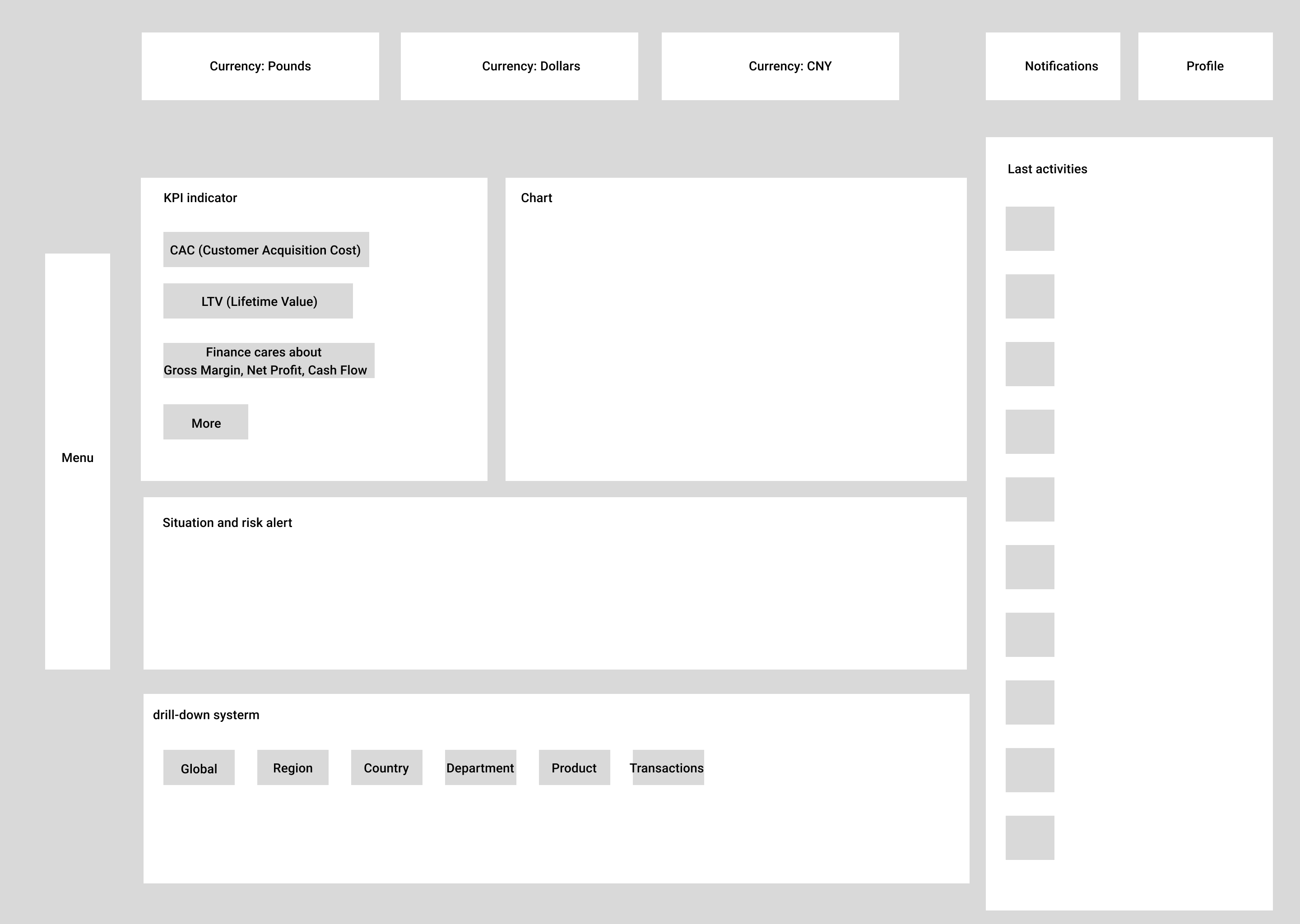
KPI low-fi prototype
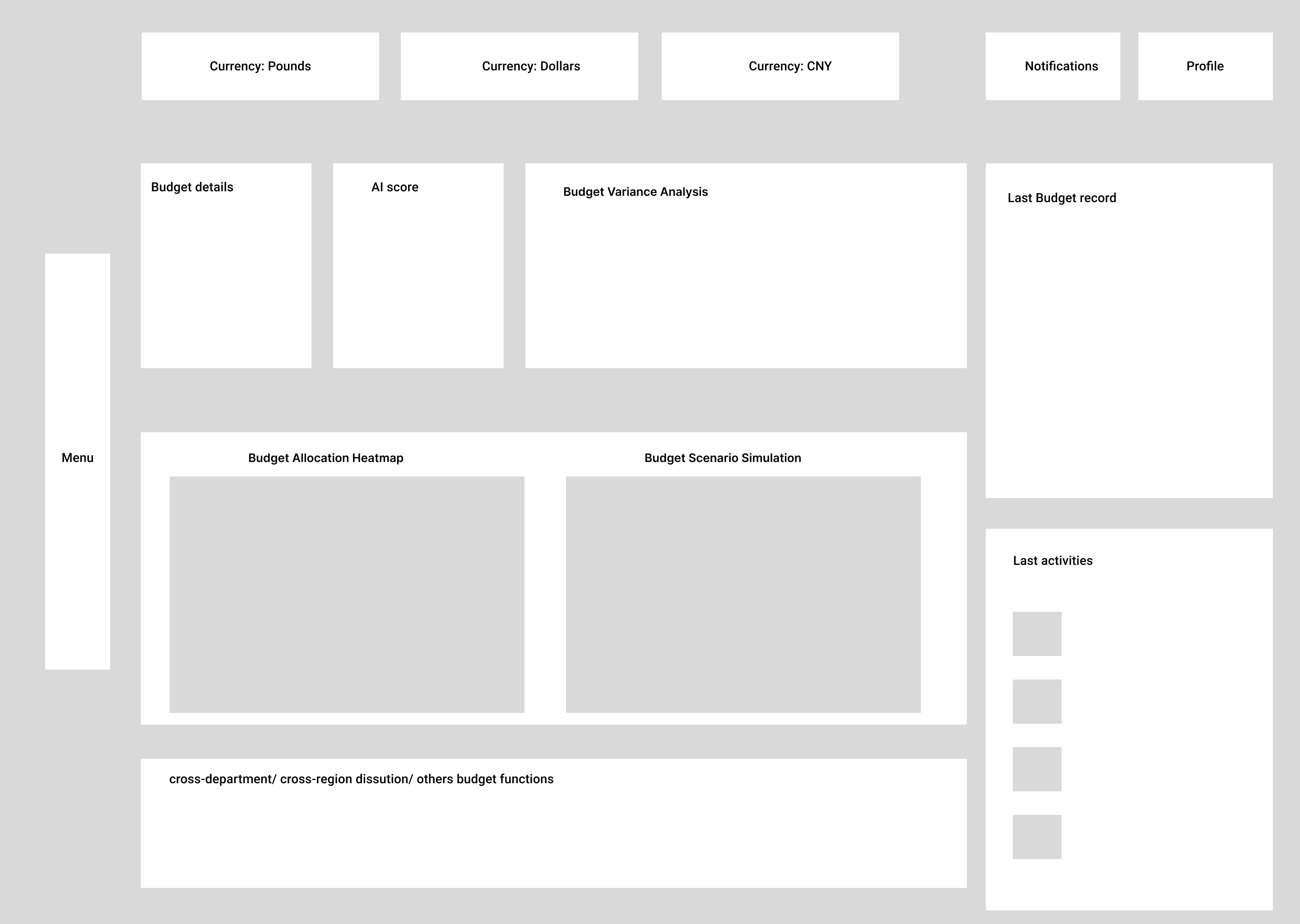
Budget low-fi prototype

Iteration

I conducted iterative refinements on key screens through multiple rounds of feedback, progressively enhancing visual hierarchy, optimizing layouts for readability, and adding contextual elements to improve usability and alignment with user needs.

Added residual background elements from the previous step, enhanced the avatar, and optimized the padding.. Optimized the ‘frame-in-frame’ structure, added local headings to improve recognizability, and further refined the padding
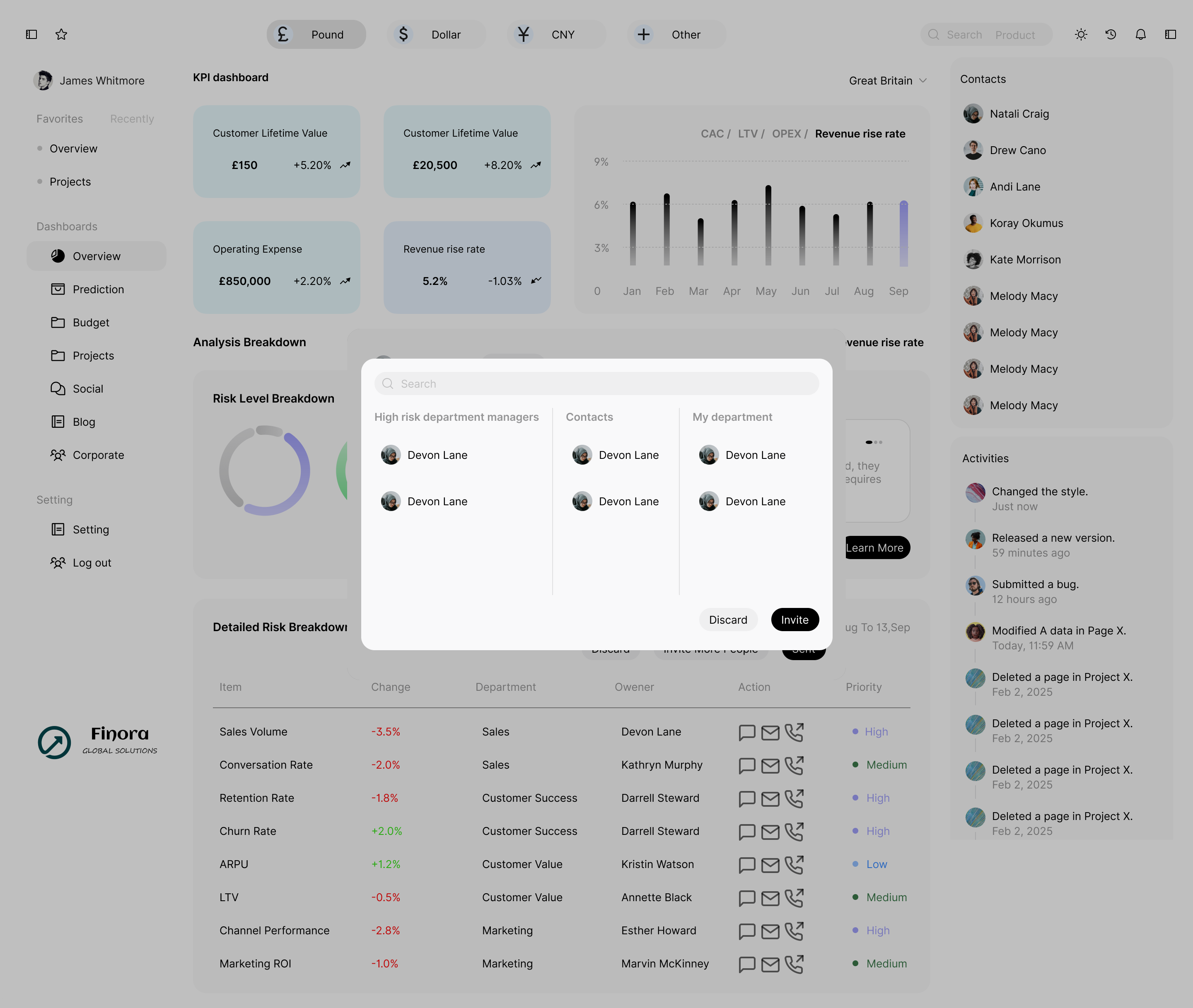
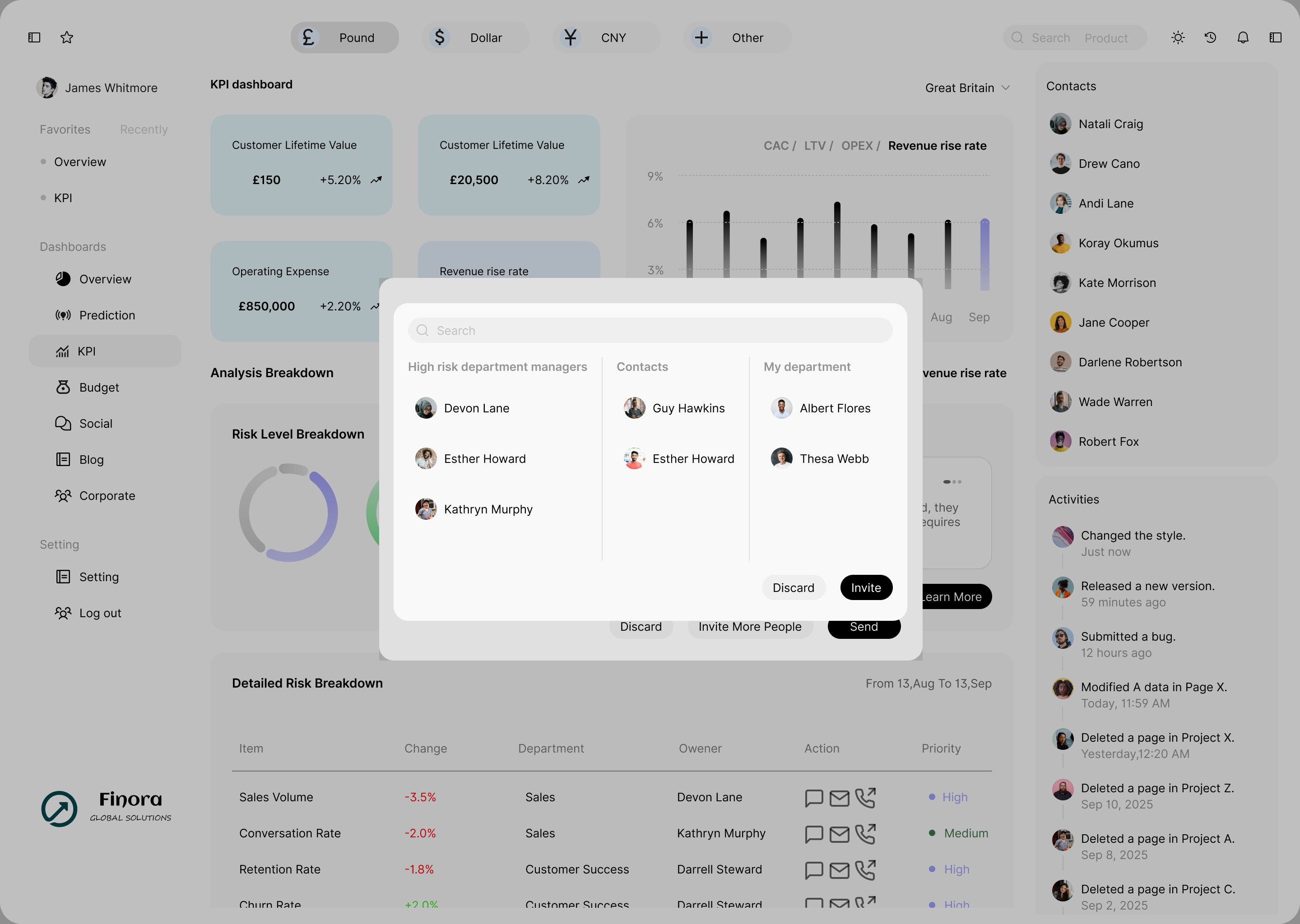
KPI prototype

Merged the cards, structured the content using a top-down (general-to-specific) approach, and arranged the corresponding functionalities.”Reworked the card format to create a more cohesive overall look and a smoother structural flow.
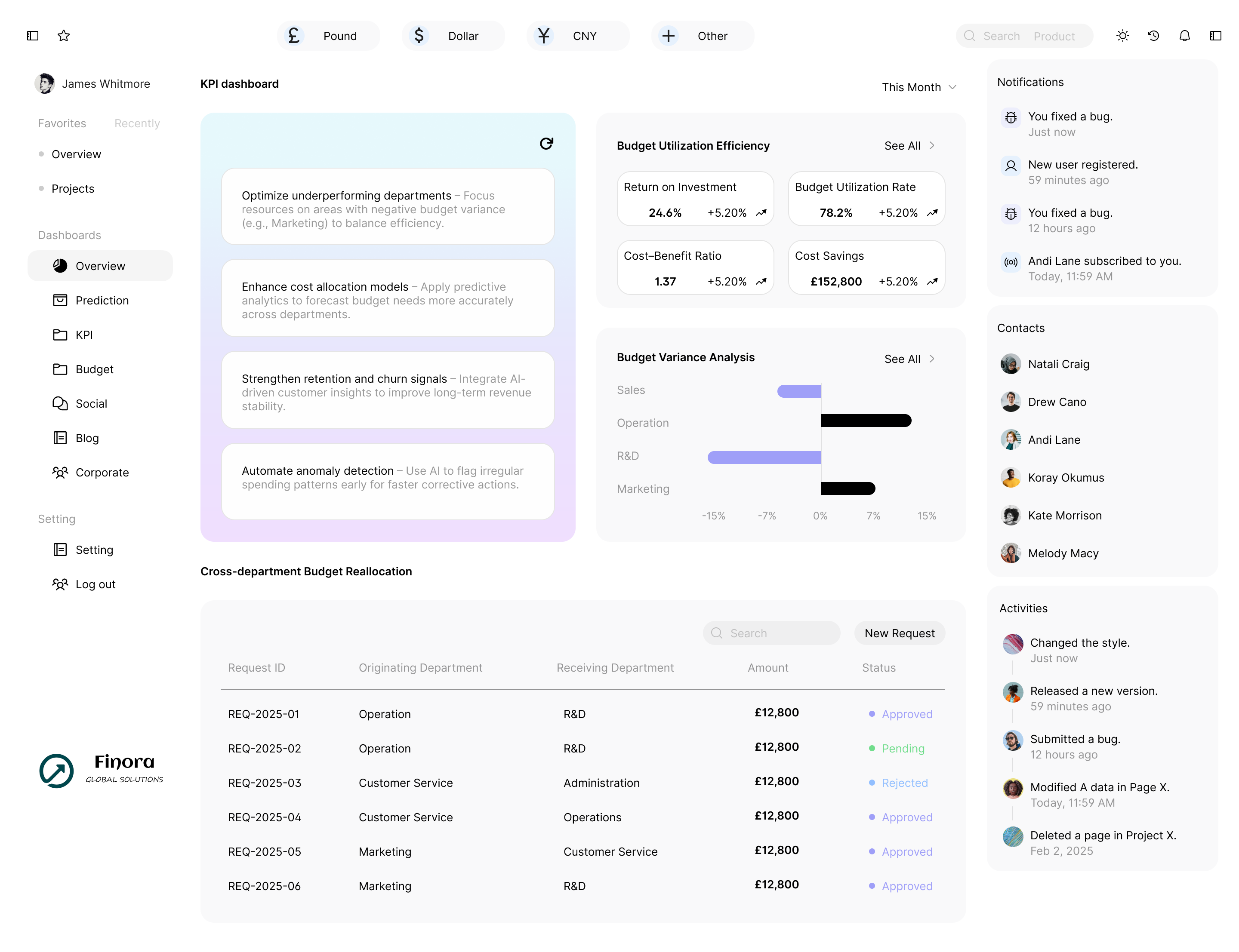
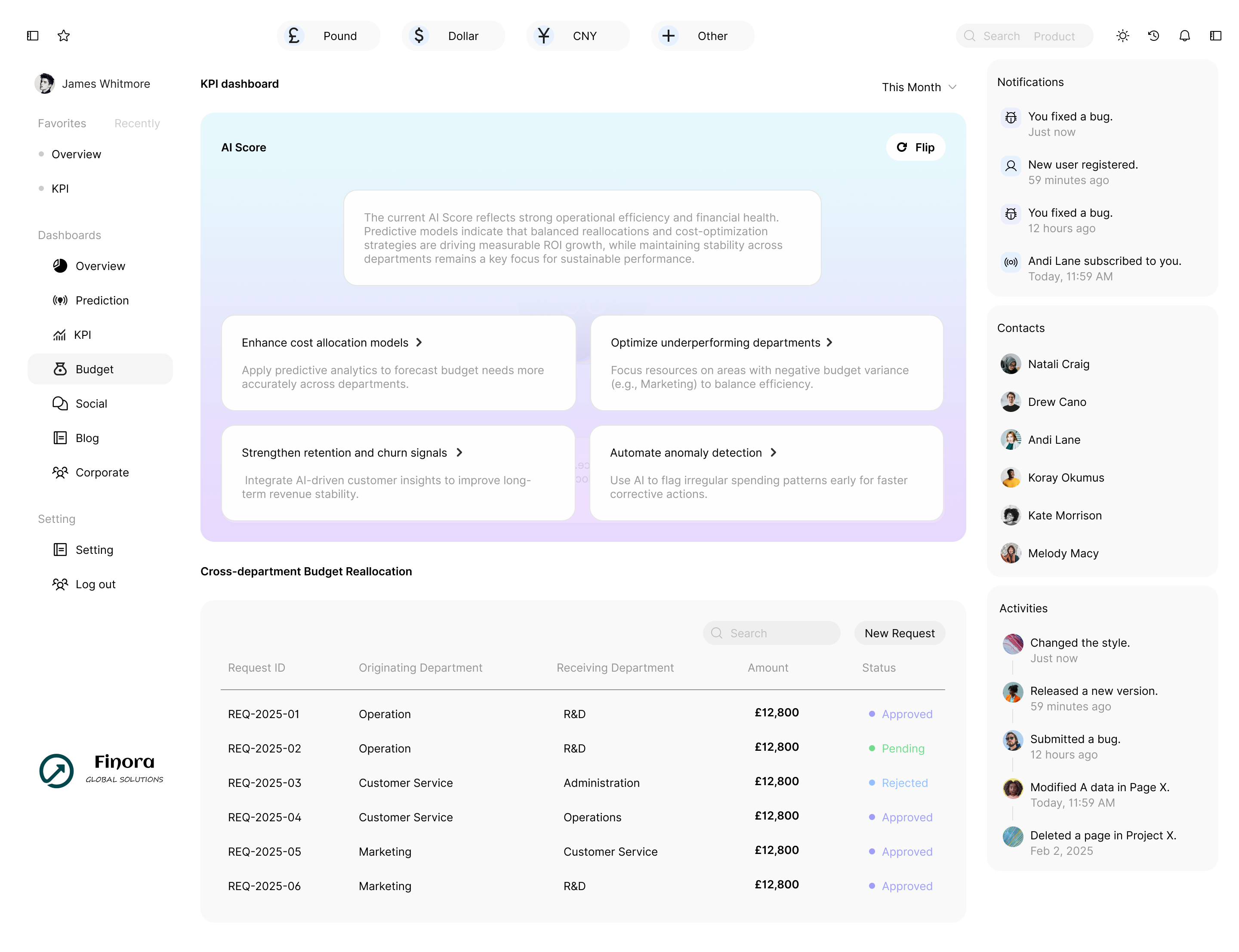
Budget prototype

Design System

I created a design system to ensure visual consistency, efficiency, and scalability across all interfaces.

Color Palette

Card Backgrounds

income

#e6f8fc

netIncome

#e6eafc

outcome

#e6f1fd

cashFlow

#e6fcfa

Chart Colors

purple

#9f9ff8

blue

#92bfff

teal

#96e2d6

green

#94e9b8

Typography

Font Sizes

xs (8px)

Sample text

sm (13px)

Sample text

md (18px)

Sample text

Headings

Heading 1

28px / bold

Heading 2

20px / bold

Heading 3

16px / bold

Data Visualization
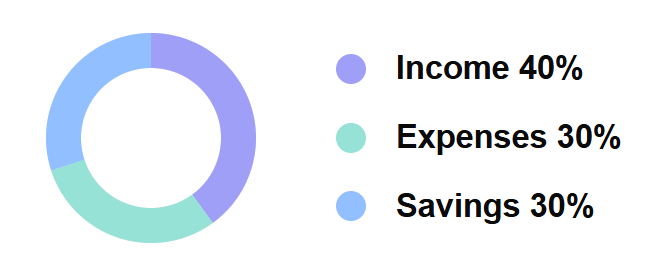
Income 40%

Expenses 30%

Savings 30%

Text Colors

Primary

#000000

Sample

Secondary

rgba(0,0,0,0.4)

Sample

Components

Stat Cards

Income

£76,700

+11.01%

Outcome

£50,200

-0.03%

Net Income

£23,500

+11.01%

Cash Flow

£10,600

-0.03%

Buttons

Primary

Secondary

Hover

Disabled

Border Radius

8px

10px

12px

16px

Spacing, Shadows & Icons

Spacing Scale

4px

8px

12px

16px

24px

32px

Shadow Levels

Small

sm

Med

md

Large

lg

Icon System

up

down

chart

filter

Interaction Flow

I designed four core interaction flows—Central Dashboard, Predictive Insights, KPI Tracking, and AI-based Score to meet different roles need.

Central Dashboard

Provides a real-time overview of key financial metrics in one centralized view.

Predictive Insights

Uses historical data to forecast trends and highlight potential financial risks.

KPI Tracking

Consolidates core KPIs to support faster, data-driven decision-making.

AI-driven Score

Summarizes financial performance into a single, easy-to-understand intelligence score.

Hi-fi Prototype
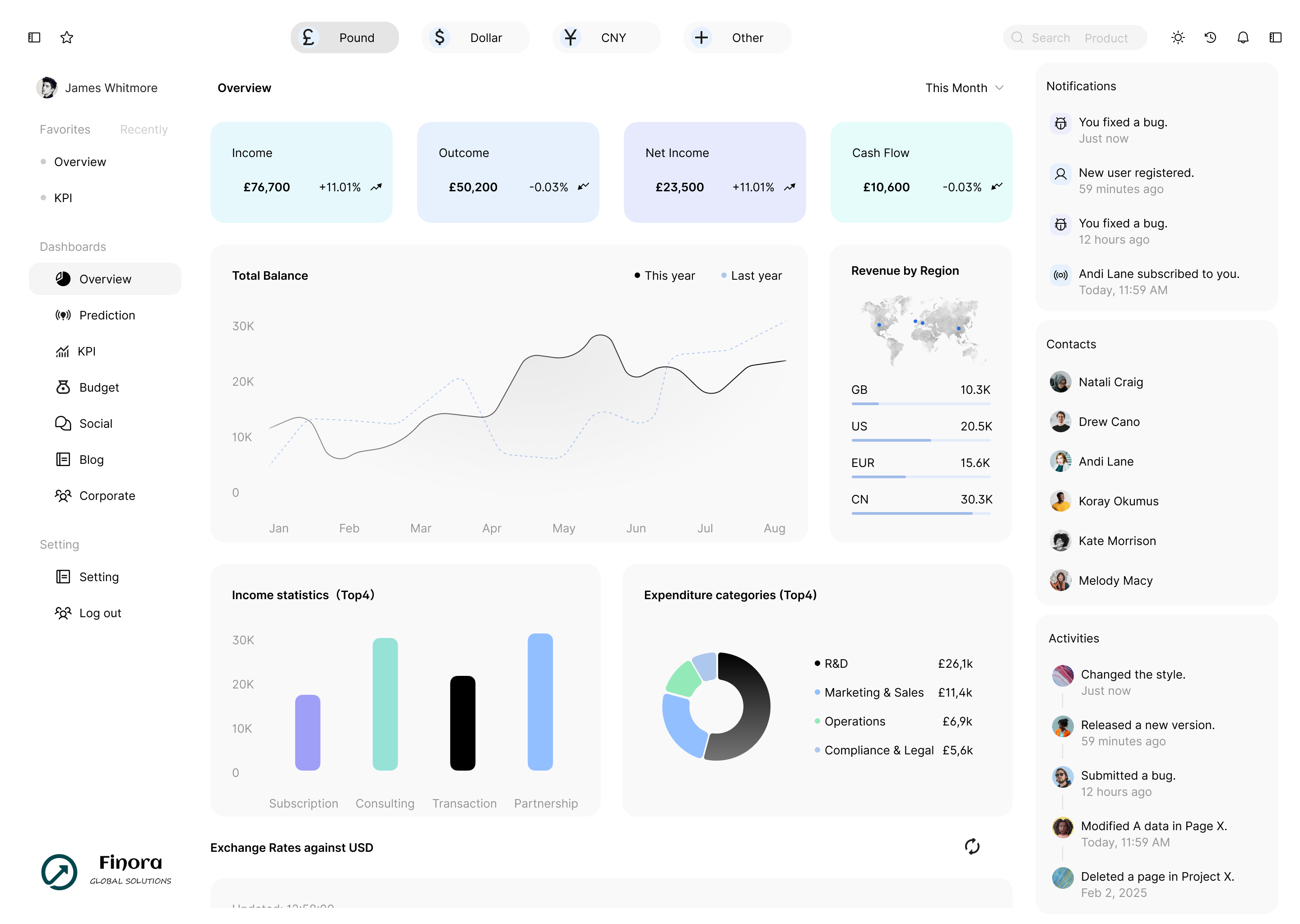
Dashboard hi-fi prototype
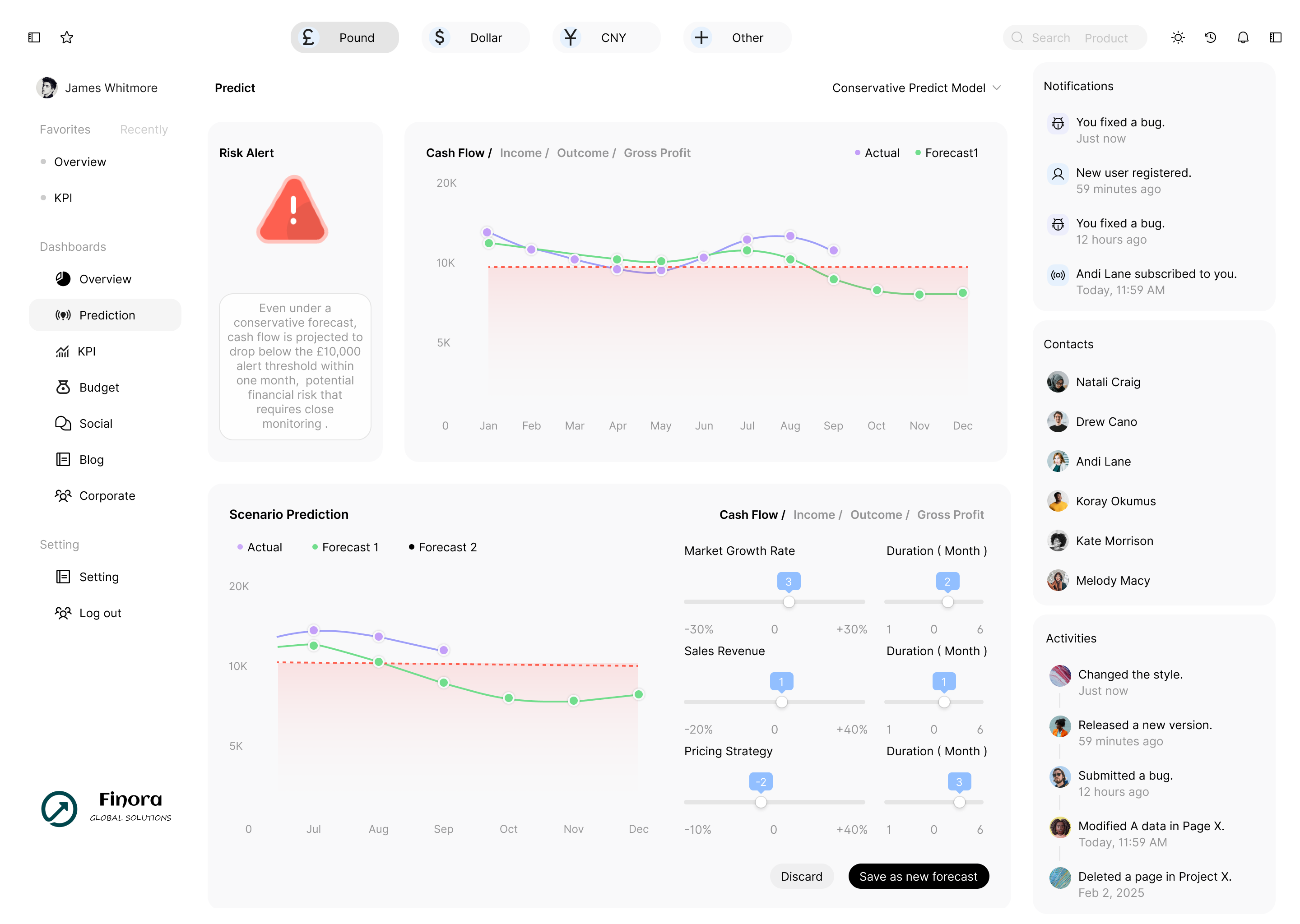
Prediction hi-fi prototype
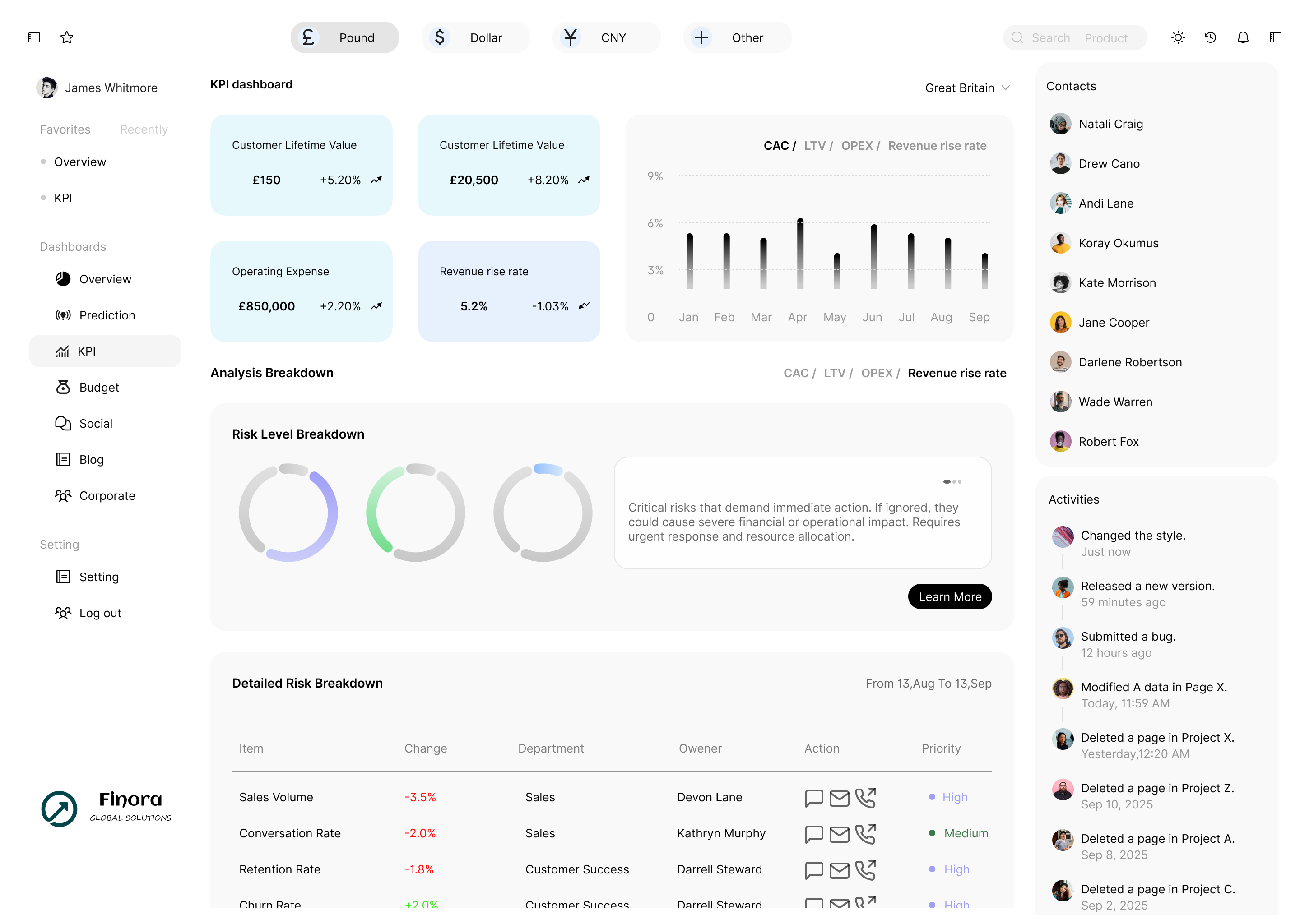
KPI hi-fi prototype
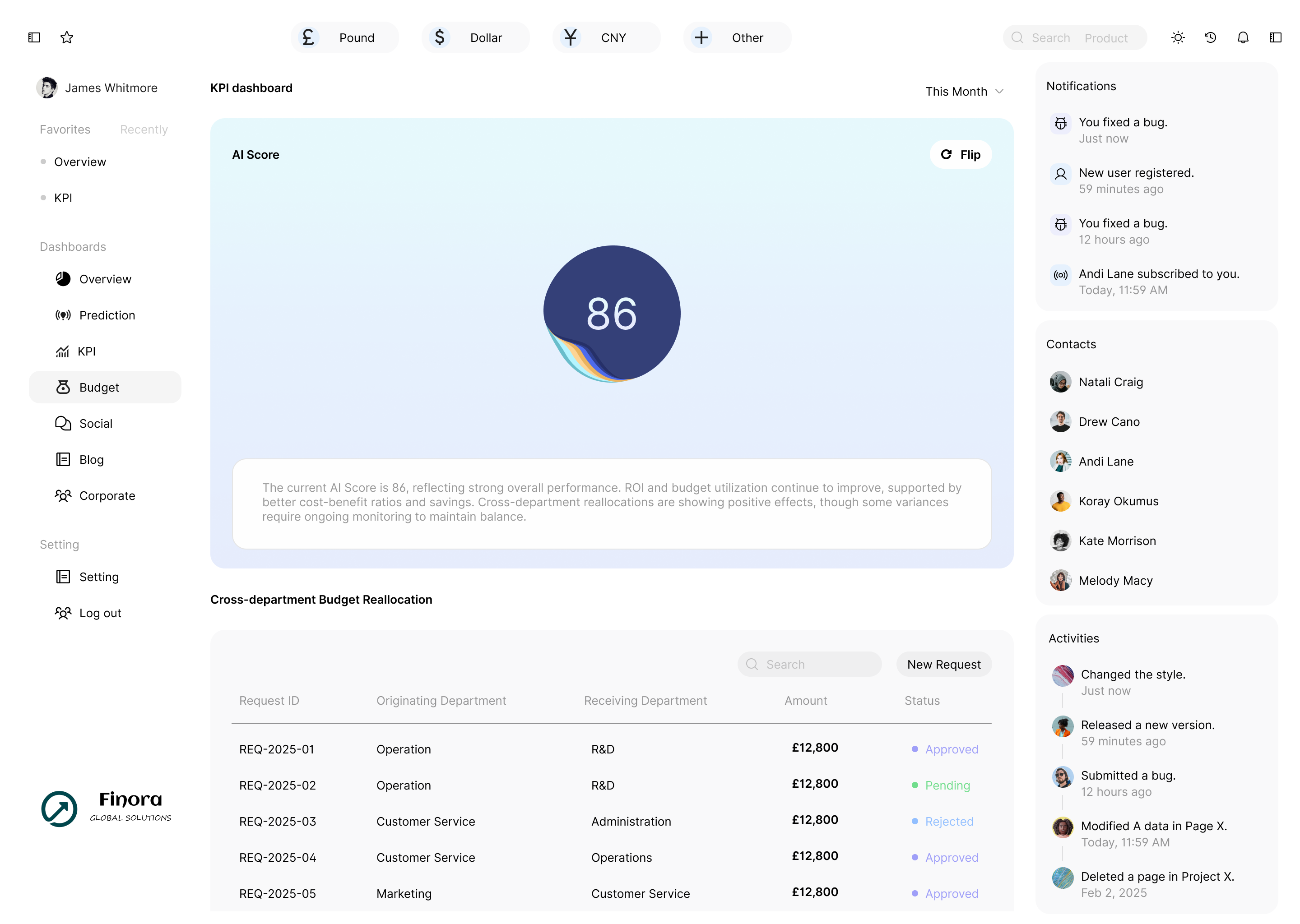
Budget hi-fi prototype

Self-reflection

Through user research and persona analysis, key pain points across Finora’s finance team were synthesized into five core insights.

These insights bridge the gap between user needs and design strategy — transforming research findings into actionable design opportunities that guided the creation of the dashboard’s core functions and value propositions.

View Last Case Study

View Next Case Study